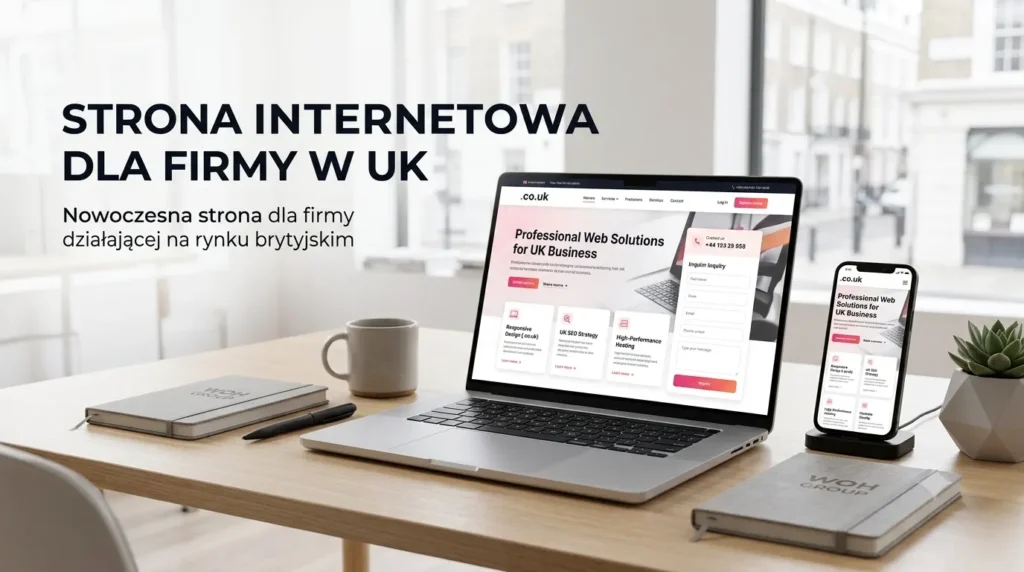
A website for a Polish-owned business in the UK often serves two audiences: the broader British market and Polish-speaking customers. A successful bilingual site does more than translate headings. It uses local terminology, clear language relationships, credible UK business signals and search strategies for each audience.
Should you use a .co.uk or .com domain?
A .co.uk domain is a clear UK market signal. A .com can be appropriate for a business serving several countries or an established international brand. The extension alone does not create rankings; language, location, useful content, links and business profiles all contribute.
Keep the domain under company ownership and configure SSL and professional email correctly. Avoid splitting languages across unrelated domains without a migration and measurement plan. One site using clean language folders is often easier to manage.
How should the two languages work?
A full English version is essential when the business wants British customers. A Polish landing page may support a campaign, but businesses serving the Polish community benefit from Polish service pages, FAQs, case studies and contact information.
WPML should connect true equivalents, and the language switcher should open the matching page rather than the homepage. Each version needs its own title, description, H1 and naturally written copy.
- localise service terminology rather than translating mechanically
- show the correct currency and commercial terms
- state the genuine service area and contact options
- use hreflang, canonical tags and consistent WPML relationships
- do not index empty or partially translated pages
What builds trust in the UK?
UK customers expect a clear scope, verifiable company information and evidence. Consider Companies House details, genuine service area, phone number, availability and transparent terms. Reviews and Google Business Profile are especially important for local services.
Case studies should explain the problem, work and outcome rather than showing only a screenshot. Where relevant, present insurance, professional memberships or sector certificates accurately and in context.
SEO for the British market
Research English queries separately. A Polish phrase and its literal English translation may produce different results and buyer expectations. Start with services and locations the business genuinely covers.
Avoid mass-producing thin city pages. A useful local page includes specific services, regional evidence, travel area, FAQs and real contact details. Connect it with Google Business Profile and consistent business listings.
- Google Search Console configured for the correct domain
- Google Business Profile and a review process
- service pages using natural British terminology
- local case studies and original project photography
- LocalBusiness or Service schema only when details are genuine
- conversion tracking for forms, calls and messages
Common bilingual website mistakes
Automatic translation without editing is a frequent problem. The English copy sounds unnatural, while currency, forms and calls to action remain Polish. Another issue is unconnected versions that leave users and search engines unable to understand their relationship.
Do not pretend to have offices in multiple cities. State the real service area and build credibility with projects and reviews. Consistent company information is more valuable than repeating location names in every heading.
Planning a bilingual UK business website?
WOH GROUP builds bilingual WordPress websites with UK SEO foundations, hosting and ongoing support, combining Polish communication with British market requirements.